Inside the high-stakes arena of contemporary professional oversteer competition, victory is far more than purely a product of brute horsepower or behind-the-wheel aggression. Conversely, it has evolved into a complex discipline which necessitates a meticulous fusion of selecting a inherently capable car, arming it with the highest-quality drift-spec parts, and, most essentially, understanding its live performance on the course through sophisticated vehicle dynamics analysis tools. This definitive guide functions as your master plan from the very first concept of a project car through to the final telemetry-optimized adjustments that transform a powerful vehicle into a consistent podium finisher. We will examine in detail the methodical process of chassis dynamics adjustment, demonstrating how a state-of-the-art vehicle dynamics tool like GripDial eradicates approximation and offers unparalleled clarity into your chassis's true behavior.
The cornerstone of any exceptional drift car is, indisputably, the base vehicle itself. Certain vehicles have achieved legendary reputation within the international sliding scene due to their built-in handling characteristics, strong design, and the immense ecosystem of performance parts available. Choosing the optimal starting point is the initial and most significant selection a builder will make. As an example, the the E36 generation BMW is universally acknowledged as perhaps the the greatest all-around drift platforms of history. Its near-perfect balanced front-to-rear weight, combined with a RWD setup and extremely reliable six-cylinder powerplants, creates a platform that is simultaneously forgiving for novices and extremely capable in the possession of a pro driver. The successor of this lineage, the BMW E46, refines these attributes with a more sophisticated chassis, broader wheel track for enhanced stability, and still more steering angle as standard from the OEM. A distinct formidable contender in the pro arena is the Corvette C6.
This muscle-derived sports car offers a particular combination of benefits to the drifting world, including a low-mass alloy structure, a rear-mounted transaxle that aids in an ideal weight distribution, and the tremendous torque of a large-displacement LS V8 motor. This fusion transforms it into an complete weapon on track, capable of entering and sustaining continuous drifts with seemingly easy application of power. For those seeking remarkable bang-for-the-buck, the Nissan 350Z stands out as a prime choice. It is delivered from the manufacturer with a robust platform, a competent original LSD, and the smooth VQ series powerplant that delivers ample horsepower and torque for learning and progressing in the activity. Its newer version, the Nissan Z34, offers more improvements in chassis stiffness, suspension design, and peak motor performance, establishing its position as a favorite choice among serious competitors. Other legendary platforms that warrant attention include the nimble rotary-powered Mazda FC, the ever-present Nissan S13, the V8-powered Ford Mustang SN95, the modern E90 3 Series, and the compact yet incredibly playful and forgiving Mazda MX-5. Each of these platforms offers a unique array of traits, challenges, and potentials, but they all have in common the basic elements necessary to serve as a serious drift machine.
However, choosing the correct chassis is only the beginning. To unlock the complete performance of any of these vehicles, substantial upgrades to the steering system and suspension systems are absolutely essential. This is where the domain of specialist aftermarket parts comes into sharp focus. The single most transformative improvement for a dedicated drift machine is the installation of a maximum-angle steering angle kit. These sophisticated systems, such as those engineered by industry leaders like specialist manufacturers, are designed to significantly increase the car's maximum turning lock. A factory road car is severely constrained in how far its tires can pivot, a design trade-off for daily operation. In oversteer driving, but, aggressive opposite lock is continuously necessary to manage and hold a angle. An steering kit exchanges the OEM hubs, linkages, and often A-arms with components that permit the wheels to achieve angles over 70 or even 80 °, as opposed to a typical stock limit of around 40 to 50 degrees.
This tremendously expanded lock offers the pilot with dramatically enhanced command during a angle, making it far more straightforward to initiate a oversteer moment, sustain it through a sweeping turn, and transition fluidly from one side to the other. The difference in drivability is truly revolutionary. Coupled with a properly chosen steering kit is the equally critical modification to the vehicle's spring and damper setup. Store-bought or even high-end road coilovers are generally not designed for the unique and extreme demands of sliding. A purpose-built system of adjustable dampers is paramount. These engineered suspension components incorporate specific valving and spring stiffness that are optimized for the extreme weight transfer that is characteristic of drifting. When a driver starts a angle, the chassis's weight is shifted rapidly to the outer of the turn. Optimal performance dampers manage this shift in a predictable way, allowing the vehicle to stabilize quickly and providing the operator clear feel through the wheel and seat. They additionally allow for precise adjustment of ride height, rebound and compression rate, and cross-weight, which are all fundamental parts of fine-tuning the car's handling to a particular circuit or driving technique. As a system, a precision-engineered angle modification system and a properly chosen system of performance suspension units constitute the undeniable hardware foundation upon which all later refinement is based.
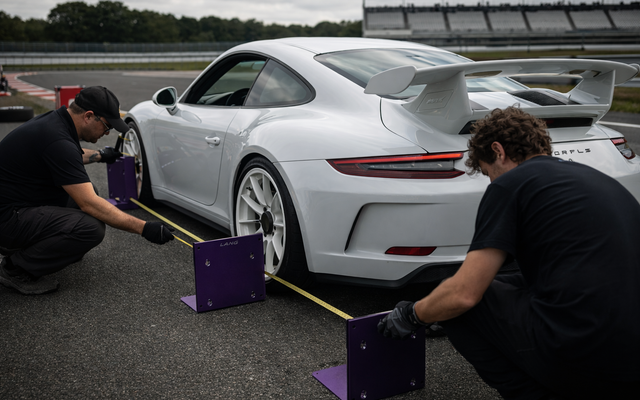
Once the core components is fitted, the next critical step in the project is the meticulous tuning of the chassis's alignment. This is the world of car suspension tuning, a process that can feel overwhelmingly complex to the beginner but is, in reality, the key to turning a assembly of high-performance pieces into a unified and controllable vehicle. The most critical aspect of tuning for oversteer is undoubtedly negative camber. Camber angle is the angle of the rim in relation to the upright axis when viewed from the forward of the vehicle. If the upper part of the tire is leaning towards the chassis, this is called negative camber. In oversteer driving, inward-leaning wheels on the front tires is widely used and is regarded as essential. The reason is deeply related to tire contact.
When a car is cornering at limit slip angles, the frame rolls toward the external of the turn. This lean forces the outside front tire to lose its ideal grip area with the tarmac. By introducing inward lean, the wheel is pre-angled to counteract this tilt. As the chassis leans into the bend, the outside front tire flattens out on the asphalt, maximizing its bite at the critical point when it is absolutely essential for directional command. Usually, front angles for a serious drift machine vary from approximately -3 degrees to as extreme as -5 degrees or even greater, based on the specifics of the chassis geometry, compound selection, and pilot preference. The rear wheels also use negative camber, but the settings are generally more conservative and less aggressive than the front axle. Excessive negative camber at the back can result in the chassis excessively prone to oversteer and hard to predict on acceleration use, as it shrinks the effective grip area of the powered wheels during linear power delivery. Thus, rear angles are commonly in the range of -1 degree to -3 degrees, finding a careful balance between giving enough side grip to aid in entering and holding the slide while simultaneously maintaining good hook-up for acceleration the bend. alignment is just one component of the larger tuning equation, which furthermore encompasses toe setting, caster, and bump steer correction.
Toe angle refers to the angle of the tires when viewed from a bird's-eye view. Inward toe means the front edges of the wheels are closer together than the trailing edges, while negative toe means the reverse. For oversteer, a slight amount of front axle toe out is frequently employed to quicken the initial handling feel, making the vehicle feel more nimble and eager to start a slide. Rear toe setting is typically set to zero or a very small amount of inward toe to foster predictability under acceleration. caster angle is the longitudinal or rearward tilt of the kingpin axis when looked at from the side of the vehicle. Increased positive caster enhances self-centering and high-velocity stability, and it furthermore adds to inward lean gain during steering, which is highly advantageous. Adjusting these settings is a complex dance where a change to one value can and often will affect the other settings. The traditional approach for setting a car's alignment for competition has long been a time-consuming process of trial and error. A pilot or engineering group would apply a change based on experience, drive the car on track, use the operator's personal perception and impressions, and then make a further tweak. This cycle would continue time after time until the car felt "right" or the scheduled practice time ran out. This approach is not only extremely wasteful in terms of man-hours and resources, but it is additionally deeply flawed.
Driver feel is a infamously inconsistent measurement tool, colored by countless factors such as tiredness, varying track surfaces, temperature, and simply the mood of the driver on that particular run. What feels "oversteery" on one run might feel "pushing" on the following pass, leading to conflicting information and frustrating adjustments. This long-standing challenge in chassis setup is precisely where modern telemetry systems has stepped in to completely change the landscape.
The rise and integration of specialized vehicle dynamics tools has brought about a new paradigm for engineering and perfecting competitive drift machines. These tools, showcased by groundbreaking solutions like data acquisition tools, function by physically capturing the live physical performance of the vehicle as it is being driven on the track. As opposed to relying on subjective feedback, these systems gather quantifiable metrics on essential parameters such as shock absorber movement, corner velocities, lateral and longitudinal g-forces, wheel angle, and driver input input. This acquired telemetry is then interpreted by powerful software that can visualize and interpret the information in a clear manner. For the first time, tuners and builders can visualize precisely what the vehicle is performing at every millisecond of a drift. This capability transforms the complete chassis setup workflow. Think about the particular task of dialing in the front negative camber for a specific chassis. Rather than making a modification from -3 degrees to -3.5 degrees and then running several runs to try and "feel" a improvement, a telemetry system can give immediate and clear information. The software can display in a chart how the suspension's contact patch is performing during the key moments of a drift: turn-in, sustain, and changing direction. It can demonstrate if the current angle is enabling the loaded tire to achieve optimal contact or if the tire is over-stressed on its outside shoulder.
The software can after analysis provide fact-based recommendations for adjustment. Perhaps the telemetry indicates that the tire is still stressing its edge at -3.5 degrees of camber, indicating that an increase to inward lean, say -4 degrees, might be advantageous. On the other hand, the information might indicate that the tire is not coming up to temperature or that the inner edge is degrading unevenly, which could point to that there is excessive inward lean and a small reduction back to -3.2 degrees would be more ideal. This degree of precision and actionable analysis was completely unattainable in the drift suspension tuning guide days of pure mechanical adjustment.
The effect of using a comprehensive vehicle dynamics tool reaches much further than just optimizing alignment. It serves as an invaluable coilover setup tips that is specific to your specific car. When setting the rebound and compression settings on your suspension, instead of relying on imprecise advice or replicating another team's setup, you can utilize the telemetry to analyze how the chassis is performing in relation to your changes. The application can display the suspension engineering damper movement path over a run, highlighting if the dampers are managing the body movement optimally or if they are permitting the chassis to oscillate excessively after a transition. It can aid in pinpointing problems like hitting the bump stops or losing droop, enabling you to make data-backed choices to helper springs, damping values, or ground clearance. This approach applies similarly to the complex art of car alignment tuning. In addition to camber, the tool can offer analysis into how changes to toe settings and caster angle are affecting the car's balance during specific maneuvers of a slide. For instance, it can help you to ascertain the ideal amount of front axle negative toe for your specific steering configuration and piloting technique by showing the speed of initial response and the stability of the car at maximum countersteer. This makes the system an extremely powerful performance optimization handbook that is constantly calibrated by the actual performance of your own car on the track. It shifts the whole process from a subjective skill into a scientific development procedure.
Additionally, the value of a system like GripDial is not limited to experienced teams with large funding. For the club-level enthusiast, it acts as an powerful educational tool. It in essence offers the tuner with the insight of a professional dynamics engineer without the corresponding expense. It drastically shortens the development time by giving definitive solutions to questions that would traditionally take seasons of trial and error to solve. A builder can see how their specific chassis behaves to specific inputs, building a deeper comprehension of vehicle dynamics in the endeavor. It additionally makes accessible professional suspension engineering principles, enabling every enthusiast with the drive to optimize their car to do so in a structured and successful fashion. This is especially valuable in a sport like drifting, where engineering know-how has traditionally been a closely guarded advantage among professional drivers. In the modern era, that capability can be in the toolkit of any motivated driver.
In conclusion, the process to engineering and dialing coilover setup tips in the ideal championship-contending drift car is a multi-stage project that seamlessly integrates time-honored engineering knowledge with revolutionary digital solutions. It begins with the wise pick of a proven car, then built upon the installation of essential competition hardware like drift-spec drift angle kits and correctly specified performance adjustable dampers. The build then moves into the intricate stage of chassis dynamics adjustment, where values like negative camber, toe, and caster angle are carefully set to match the chassis's upgraded geometry and the pilot's specific style. The final step, and what truly distinguishes the contemporary approach from the past, is the integration of a powerful suspension tuning application. This system removes the approximation and waste of purely subjective setup by giving quantifiable, actual telemetry on how the chassis is actually functioning. It serves as an indispensable engineering partner, a definitive alignment optimization handbook, and a all-in-one performance analyzer. Together, this complete philosophy ensures that every element of the competition vehicle—from the selection of the chassis to the final tweak on the damper—is refined for peak competitiveness on the competition venue. It embodies the total evolution of the art of oversteer driving, connecting mechanical driving skill with precise suspension engineering to create the ultimate competitive machines possible.